Exloring value of Vietnamese banh mi

Being found literally everywhere in Vietnam and in Vietnamese enclaves around the world, banh mi or Vietnamese-style baguette had been a street specialty long before street food became an obsession. The Hanoi Times looks for the value of the Vietnamese specialty on a global scale.
A wonderful flavor from Vietnam
| The yummy banh mi from Huong Lan Bakery in Hanoi with a variety of fillings. Photo: Tung Boo |

The baguette arrived in Vietnam during French colonialism, and nowadays it is one of the few happy legacies from the time.
According to local food experts, the crusty bread, its condiments, and stuffings are all a legacy of French colonialism, while cilantro, chili, and pickles reflect the Vietnamese taste for fresh vegetables and lively flavors.
The simple yet yummy delicacy with a variety of versions is very popular, equivalent to Pho or Vietnamese traditional noodle soup. The “classic” banh mi appeared a dozen decades ago and though many have brainstormed a better baguette version, the original still stands strong.
Fillings include roast pork, grilled chicken, or beef meatballs together with homemade pâté, cured ham, shredded pork, cheese, thin layers of radish and carrot, slices of cucumber, a generous sprinkling of cilantro leaves, and pepper and chili sauce mixed with a little mayonnaise.
| Basic ingredients for Vietnamese-style banh mi are coriander, cucumber, sausage, sweet-and-sour sauce, among many others. Photo: Hanh Nguyen |

For many foreigners, it might sound as though everything lying around is used, but it wonderfully blends all together in a delectable way.
Vivian Bancroft, an Australian expat in Hanoi is a fan of banh mi. “Once you bite into a well-stacked banh mi, you are sure to have a moment of heaven,” she told The Hanoi Times, “It is so crunchy, soft, aromatic, spicy, salty, sour, sweet, and savory.” Then the dish soon becomes one of her favorites for breakfast.
According to Luong Thanh Nghi, Vietnamese ambassador to Denmark, banh mi is not only street food but has also gradually become more and more popular abroad. “It is even considered as ‘an ambassador of Vietnamese cuisine and culture’ nowadays. When it comes to banh mi, it means Vietnam!”, Nghi once commented on bread.
In searching for the value of banh mi
| The banh mi Huong Lan with great fillings. Photo: Tran Kem |

On the same level as the American hamburger, Italian pizza, Korean kimbap, and Japanese sushi, banh mi is the signature fast food of Vietnam. Besides “ao dai” and “pho”, “banh mi” is a Vietnamese word included in the Oxford English Dictionary – one of the world’s most prestigious dictionaries of the English language.
The dish has also been added as a new term to the famous American dictionary Merriam-Webster in the 2022 edition.
So, what creates the value of the Vietnamese-style baguette on a global scale? Let’s come to “the King of Bread” Kao Sieu Luc- the so-called “The King of the Bread in Vietnam” for the answer.
The man owns a famous bakery brand in Vietnam that supplies hamburger bun and bread to major international fast-food chains in Vietnam like McDonald’s, Burger King, Lotteria or Dunkin’ Donuts, coffee house chains like Starbucks or The Coffee Beans & Tea Leaf, as well as malls and convenience stores like Aeon, FamilyMart, Circle K, among others.
“It’s because banh mi is more aggressive than sponge cake”. That was Luc’s reply when someone asked why he had started with sponge cake and then became the “King of Bread”. In other words: what is so captivating about banh mi that made him devote his life to this dish?
Back in 1992, Kao embarked on his journey with banh mi. It was “a tearful beginning”. After struggling with the aggressive companion for two years, he concluded that with banh mi’s limitless potential, he could never stop learning about it.
As a result, he traveled to Japan in 1994, to France two years later, then to the US, Belgium, Germany, and other countries in his quest to improve the quality of Vietnamese bread and make a difference.
Great passion for bread
| ‘King of bread’ Kao Sieu Luc and his creation of banh mi made from dragon fruit. Photo: Tri thuc tre |

Kao found that the French had left French cuisine in Saigon, including the long thin baguette with crispy crusts. He believed that Westerners’ healthy bones and teeth were thanks to their habit of eating cheese and drinking milk since their childhoods. Meanwhile, Vietnamese people had weaker teeth and bones due to insufficient nutrition, so they needed a softer type of bread than the baguette.
Step by step, Kao learned about fermentation in France, how to use the sourdough starter and additives in Belgium, sourdough and dark bread in Germany, and meticulousness and presentation in Japan. In addition, he also adopted science and technology – one of the deciding factors in successful production – in the US.
After collecting the quintessence of different culinary worlds, Kao came back to his homeland and made his own products, whose flavor conquered a variety of gourmets and became globally famous.
| Banh mi made from dragon fruit by Kao Sieu Luc. Photo: ABC Bakery |
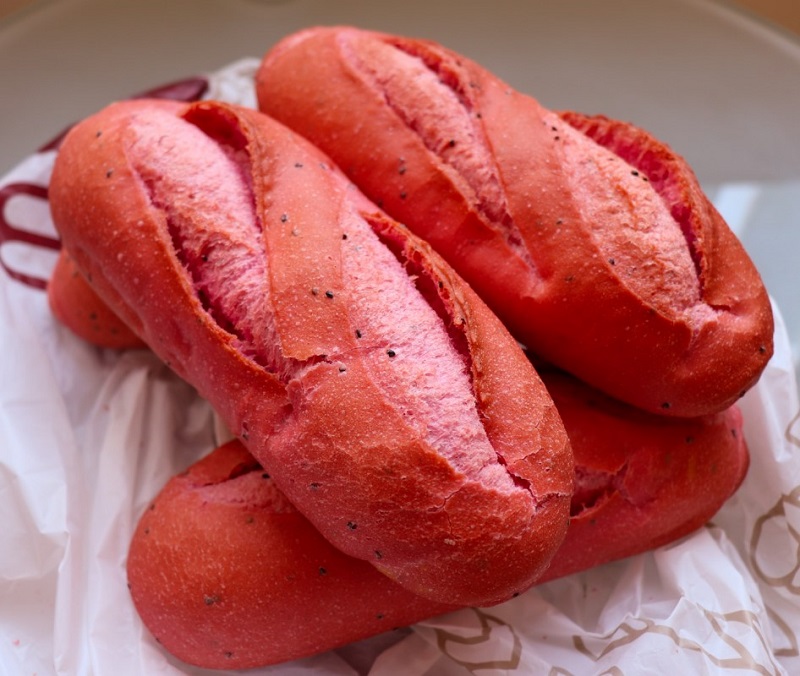
In early 2020, in order to support dragon fruit planters, Kao Sieu Luc began to experiment with dragon fruit bread. After several failures, the final product has captured the market and drawn the attention of consumers. The creator even published his recipe on the Internet so that more people can prepare the dish and farmers can sell more fruit.
Similarly, for frontline workers to have nutritious meals during the Covid-19 pandemic, Kao invented a type of black bread with walnuts, raisins, cheese, dried Japanese sweet potato, and black sesame seeds. He called it “nutritious bread”.
Green and clean “nutritious bread”, or organic bread, is also his future target. Kao even let us in on the “fish sauce bread”, with fish sauce being used in place of salt to make one-of-a-kind bread. Replying to everyone’s skepticism about this strange dish, he affirmed: “It will work!”
The post Exloring value of Vietnamese banh mi appeared first on Vietexplorer.com.
View more from VietExplorer:
Date palm garden emerges as new photo hotspot in Vietnam’s Mekong DeltaForeign arrivals could reach 6-8 million in 2020 if int’l tourism resumes in Q3
Van Don-Danang air route set to reopen next month
Future looks bleak for HCMC’s tourism industry
Da Nang tourism promoted on BBC
Exploring culturally-rich Van Phuc silk weaving village in Hanoi
Bilingual book introduces Vietnamese costumes in 15th century
Busan film fest big winner ‘Rom’ set to hit Vietnam theaters this July
Hanoi poised to host first international standard art auction
President Ho Chi Minh – founder of Vietnam’s revolutionary press
Quang Binh offers large discounts to boost tourism
Promotion campaign launched to boost northwestern’s tourism
Aquatic exports drop 6 percent in five months
King Coffee becomes Vietnam football’s main sponsor
Dragon fruit bread: An instant hit in Vietnam’s bakery market
Hanoi’s ‘new normal’: How much has changed for the foreigners who chose to stay?
Garbage to garden: Saigon woman upcycles scraps into garden ornaments
Hanoi’s skilled glass-blowers keeping the flame alive
Vietnam boasts of various UNESCO intangible cultural heritages
Vietnamese folk games: sitting tug-of-war and clay firecracker hurling


Nhận xét
Đăng nhận xét